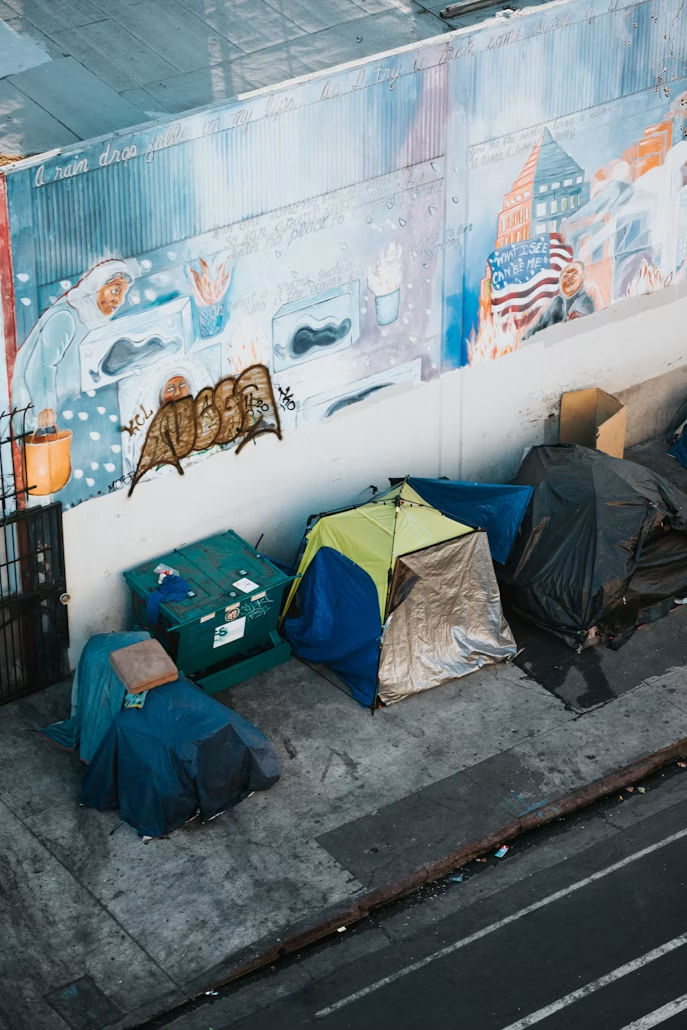
Homelessness, Public Spaces and the Search for Lasting Solutions: What Can We Learn From Santa Ana and Santa Barbara
Walk My Town — Community & Public Affairs
California communities have spent more than a decade struggling with one of the state’s most visible and difficult public-policy challenges: how to assist people experiencing homelessness while keeping downtown districts, parks, beaches, transit stations, sidewalks and other public spaces safe and accessible to everyone.
Even the words used to discuss the issue have become part of the public conversation.
Terms such as “homeless people,” “the homeless,” “unhoused people,” “persons without homes,” and “people experiencing homelessness” are frequently used interchangeably. Government agencies and service organizations increasingly use people experiencing homelessness or unhoused residents, emphasizing that homelessness describes a person’s housing situation rather than defining the person.
The terminology matters, but communities ultimately have to confront the underlying problem: Where does a person go after leaving an encampment?
Santa Ana and Santa Barbara provide two useful California case studies.
Santa Ana: From a Civic Center Encampment to a Housing-and-Shelter System
Santa Ana’s experience is particularly significant because homelessness became highly concentrated around its Civic Center.
As early as 2016, Santa Ana was publicly developing a strategy specifically aimed at reducing homelessness in the Civic Center. City documents described permanent supportive housing, incentives for landlords to accept people receiving housing assistance, motel vouchers, transportation assistance, coordinated nonprofit services and connections to mental-health and emergency services.¹
By 2017 and 2018, the Civic Center had developed into a major encampment around government buildings and public spaces. The large encampment was eventually cleared in 2018 following outreach and intervention involving the city, county, service providers and federal-court oversight.²
Importantly, the objective was not simply to move people from one neighborhood to another.
Santa Ana subsequently expanded its shelter and housing infrastructure.
The city opened an interim low-barrier emergency shelter operated by Mercy House in 2018.³ It later developed the Santa Ana Navigation Center, which became fully operational in 2022 as a 24-hour facility with approximately 200 beds for men, women and families with children. The facility provides shelter along with services intended to help people transition toward permanent housing.⁴
Orange County also operates the Yale Navigation Center in Santa Ana, which opened in 2021 and can serve as many as 425 adults and couples. Its services emphasize stabilization, permanent-housing placement and reintegration into the community.⁵
Santa Ana has also invested in permanent supportive housing.
The results provide an interesting picture.
The city’s 2019 Point-in-Time Count identified 1,769 people experiencing homelessness in Santa Ana.⁶ By 2024, that figure was 1,428, a decline of 341 people, or roughly 19 percent, compared with 2019. County records attributed part of that progress to permanent supportive housing and housing vouchers.⁷
However, the numbers also demonstrate why homelessness cannot be considered “solved.”
Santa Ana’s total increased from 990 people in 2022 to 1,428 in 2024, including an increase in its unsheltered population from 508 to 871.⁸
This illustrates an important distinction. A city can make substantial progress over a longer period while still experiencing serious short-term increases as housing costs, behavioral-health problems, substance-use disorders, economic pressures and regional homelessness change.
Orange County’s latest numbers offer another important development. The county’s 2026 Point-in-Time Count reported 6,321 people experiencing homelessness, down 13.7 percent from 2024. Unsheltered homelessness declined 26.6 percent, and for the first time the county counted more people in shelters than living unsheltered.⁹
Those are countywide figures and should not automatically be attributed to Santa Ana alone, but they suggest that expanded shelter and housing capacity can affect where people experiencing homelessness are living.
Santa Barbara: A Different Coastal Challenge
Santa Barbara has faced many of the same problems in a dramatically different environment.
Its homelessness challenges involve downtown commercial areas, parks, vehicles, transportation corridors, environmentally sensitive locations and areas near the coast.
Over the past decade, Santa Barbara has increasingly moved toward a coordinated system combining street outreach, encampment response, temporary shelter, behavioral-health referrals, safe parking, rental assistance and permanent housing.
Since 2019, the city has contracted with City Net to provide street outreach, case management and housing navigation. Outreach teams coordinate with police, hospitals and other service organizations rather than relying exclusively on law enforcement.¹⁰
One example came after the 2021 Loma Fire.
Santa Barbara declared an emergency concerning encampments in fire-prone areas and temporarily used the Rose Garden Inn to house people who had been living in encampments considered particularly vulnerable to wildfire.¹¹
This approach illustrates an important principle: encampment removal is considerably more meaningful when there is somewhere for people to go.
Santa Barbara has also operated rental-assistance programs for many years. Since 2012, its Tenant Based Rental Assistance program has assisted more than 330 households with such expenses as security deposits and temporary rental assistance.¹²
Vehicular homelessness has required another approach.
Through Safe Parking and an Encampment Resolution-funded program, Santa Barbara reported that by June 2025, 81 people involving 56 vehicles had enrolled in the initiative; 24 people had obtained permanent housing and another 29 had received temporary housing.¹³
Santa Barbara’s New Shelter and Navigation Strategy
Santa Barbara is continuing to expand its homelessness infrastructure.
The city reports approximately 987 people experiencing homelessness, including more than 230 people living unsheltered in vehicles.¹⁴
The city has established the FARO Center — Fostering Access, Resilience and Opportunity — as a daytime navigation center where people can obtain housing referrals, employment assistance and health and mental-health connections rather than traveling among multiple agencies.¹⁵
Santa Barbara has also acquired Casa Cacique, a year-round referral-based interim housing facility at 816 Cacique Street.
The facility provides shelter, meals, hygiene facilities, access to health care, case management, employment assistance and housing navigation.¹⁶
In September 2026, the City Council approved approximately $2.68 million for Casa Cacique services and $494,000 for FARO Center operations, reinforcing a strategy that combines immediate shelter with longer-term navigation toward housing and services.¹⁷
Has Santa Barbara’s Approach Worked?
The answer depends on how success is measured.
If success means that homelessness has disappeared from Santa Barbara, the answer is clearly no.
The 2024 Point-in-Time Count found 2,119 people experiencing homelessness throughout Santa Barbara County, a 12 percent increase from 2023. Of those individuals, 1,332 were unsheltered.¹⁸ The City of Santa Barbara itself reported approximately 987 people experiencing homelessness.
Those figures demonstrate that substantial challenges remain.
At the same time, individual programs have produced measurable housing placements, and the city has developed significantly more infrastructure for outreach, safe parking, shelter, rental assistance and housing navigation than existed a decade ago.
State data provide another measure. Between January 2023 and June 2025, state Homeless Housing, Assistance and Prevention funding in the Santa Barbara area was associated with 1,382 people connected to services and 768 people housed.¹⁹ These are regional figures rather than results attributable solely to the City of Santa Barbara, so they should be interpreted accordingly.
The evidence therefore points to partial progress rather than a completed solution.
Relocation Versus Resolution
This distinction may be the most important lesson for other California communities.
Moving an encampment does not necessarily mean resolving homelessness.
A person removed from a park, beach, train station or downtown sidewalk remains homeless if that person simply relocates several blocks away or into another community.
A more meaningful measure is whether the individual moves through a continuum:
Street or encampment → outreach → shelter → assessment → medical, mental-health or substance-use treatment when appropriate → transitional or supportive housing → permanent housing.
Not every person experiencing homelessness has a substance-use disorder or mental illness, and treatment needs should be determined individually. For people who do need behavioral-health or addiction treatment, however, connecting housing assistance with those services can be critical to achieving long-term stability.
The objective is therefore not merely to make homelessness less visible.
It is to make homelessness less prevalent.
What Santa Ana and Santa Barbara Can Teach Other Cities
The experiences of these two cities suggest that communities do not necessarily have to choose between compassion and maintaining orderly public spaces.
Cities can establish reasonable rules governing parks, sidewalks, transit facilities and other shared spaces while simultaneously investing in shelter, outreach, treatment connections and housing.
Santa Ana’s experience is especially noteworthy because its 2019-to-2024 count declined even while Orange County as a whole faced continuing homelessness pressures. Santa Barbara demonstrates how a smaller coastal city has built a network involving street outreach, safe parking, temporary shelter, rental assistance and navigation services.
Neither community has eliminated homelessness.
Both, however, demonstrate why the conversation should move beyond the question:
“How do we remove homeless encampments?”
A more useful public-policy question is:
“When an encampment is removed, where will the people living there go next — and what system exists to help them remain housed?”
That question matters not only to Santa Ana and Santa Barbara, but also to Pasadena, Glendora and other California communities confronting homelessness around downtown areas, parks and expanding transit corridors.
Footnotes & Sources
1. City of Santa Ana, City Council Minutes, March 15, 2016, Plan to Reduce Homelessness in the Civic Center and Throughout Santa Ana. The plan discussed permanent supportive housing, landlord incentives, motel vouchers, transportation assistance and coordinated services. (Santa Ana Public Documents)
2. City of Santa Ana Housing Element materials describe the Civic Center encampment and its 2018 closure under federal-court supervision with outreach and connections to services and housing. (California Housing Dept.)
3. City of Santa Ana agreement with Mercy House Living Centers for operation of an interim low-barrier emergency homeless shelter, beginning in 2018. (Santa Ana Public Documents)
4. City of Santa Ana Consolidated Plan/Homeless Needs Assessment. The Santa Ana Navigation Center opened in 2022 and provides approximately 200 beds for adults and families with minor children. (Santa Ana Public Documents)
5. County of Orange, Yale Navigation Center. The facility opened in 2021 and provides shelter and supportive services for as many as 425 adults and couples. (Orange County CEO’s Office)
6. City of Santa Ana Housing Element materials, 2019 Point-in-Time Count: 1,769 people experiencing homelessness, including 830 unsheltered individuals. (Santa Ana Public Documents)
7. Orange County Continuum of Care records report Santa Ana’s count declining from 1,769 in 2019 to 1,428 in 2024 and discuss the city’s permanent supportive-housing developments and housing vouchers. (Orange County CEO’s Office)
8. City of Santa Ana planning documents report an increase from 990 people experiencing homelessness in 2022 to 1,428 in 2024, with the unsheltered count increasing from 508 to 871. (Santa Ana Public Documents)
9. County of Orange, 2026 Point in Time Count Results, May 18, 2026. The county reported 6,321 people experiencing homelessness, including 3,256 sheltered and 3,065 unsheltered. (Orange County Government)
10. City of Santa Barbara, Homelessness Outreach & Case Management. The city has contracted with City Net for street outreach, case management and housing navigation since 2019. (City of Santa Barbara)
11. City of Santa Barbara, April 2022 homelessness update. Following the 2021 Loma Fire, the city used the Rose Garden Inn as temporary housing for people living in encampments identified as presenting significant fire risks. (City of Santa Barbara)
12. City of Santa Barbara, Tenant Based Rental Assistance. The city reports more than 330 households assisted since 2012. (City of Santa Barbara)
13. City of Santa Barbara homelessness collaborative reporting on vehicular homelessness and Encampment Resolution funding. (City of Santa Barbara)
14. City of Santa Barbara, Homelessness Initiatives. The city reports approximately 987 people experiencing homelessness, including more than 230 people living unsheltered in vehicles. (City of Santa Barbara)
15. City of Santa Barbara, FARO Center. Services include housing referrals, workforce assistance and connections to health and mental-health services. (City of Santa Barbara)
16. City of Santa Barbara, Casa Cacique. The referral-based interim housing program provides shelter and connections to health, employment and housing services. (City of Santa Barbara)
17. City of Santa Barbara, September 1, 2026 City Council actions concerning Casa Cacique and FARO Center services. (City of Santa Barbara)
18. Santa Barbara County 2024 Point-in-Time Count. Countywide, 2,119 people were counted, including 1,332 unsheltered and 787 in shelters or transitional housing. (City of Santa Barbara)
19. California State Auditor homelessness accountability data for Santa Barbara County/region. State data report 1,382 people connected with services and 768 housed through HHAP-funded activities between January 2023 and June 2025. (Accountability)
Editor’s note: Point-in-Time counts are one-night estimates rather than complete annual censuses. Methodologies and geographic boundaries can also differ among years and jurisdictions, so comparisons should be interpreted with appropriate caution.
Walk My Town welcomes factual corrections, community experiences, differing perspectives and constructive proposals.